

Sunday, March 7, 2010

February's Book of the Month: A Movie in My Pillow

A Movie in My Pillow/
Una película en mi almohada
Poems by Jorge Argueta
Illustrations by Elizabeth Gómez

The LBBC’s recommendation for February’s Libro del Mes, is Jorge Argueta’s A Movie in My Pillow/Una película en mi almohada.

Written by Ecuadorian poet, Jorge Argueta, A Movie in My Pillow is a story about a newly arrived immigrant boy. With 20 vividly written poems, Argueta presents the experience of this young boy as he leaves his homeland of Ecuador and begins his new life in San Francisco. Forced to leave his home in the country because of a civil war, Jorgito discovers a very different world in a foreign city.

Argueta’s book is a reflection of his own memories and experiences when he first came to America as a child. There is an obvious longing for his homeland, which young readers should be able to understand. But there is also a happy blending of the two cultures by the end of the book.

Mi bicicleta
es un caballo pinto
veloz como el viento

Mi bicicleta
es un dragón
que baila

cumbias
desde aquí hasta
El Salvador

The language that Argueta uses is imaginative and lively, echoing his close connection to nature and indigenous culture. He also dedicates several poems to his relationship with his grandmother, who also spoke Nahuatl, as seen in this excerpt from his poem, “Lengua de pájaros.”

Antes sólo podía
hablar español

Ahora también
puedo hablar inglés

Y en sueños
hablo en náhuatl

la lengua
que mi abuelita dice

su gente
- los pipiles -

aprendieron
de los pájaros

A Movie in My Pillow has bright, colorful illustrations by painter, Elizabeth Gómez. It comes with full text in both Spanish and English. There is no glossary in the back, and as such is best as a book for more advanced Spanish speakers. However, the poems are displayed on the same page or across from each other so unfamiliar words can easily be figured out.

This book would be a wonderful supplement to the following topics/themes: poetry, immigration, family, differences in living in the city versus living in the country, indigenous cultures, family relationships, grandparents, and nature. It is a good read for children ages 4 and up.

If you would like to buy your own copy of A Movie in My Pillow, please click here. Or you can follow the link in our sidebar to the LBBC’s on-line store. We have both new and gently used copies available.

Sunday, February 28, 2010

The 2010-2011 Tejas Star Book Awards

Next February (2011), all the children of Texas will have the opportunity to select their favorite book from the Tejas Star book list which was recently announced. The purpose of the book award is to promote reading and the many benefits of bilingualism. Books submitted for the award must meet the following criteria:

• The book must be authentic in portraying the Hispanic/Latino culture.

• The book must have been published originally in Spanish or in full Spanish/English bilingual format (not English with a few Spanish words).

• The content of the book must be appropriate for children in grades K-6.

• The book must be of high literary quality.

• The book must have received a positive review in one of the major reviewing sources or by the Tejas Star committee.

• If the book is published outside the U.S., the book must be of interest to children in Texas schools.

• The book must have a publication date between 2005 and 2010.

The LBBC is proud to say that we have reviewed some of the books listed below and we now carry all of the titles in our on-line bookshop. Clicking on the title will take you to the bookshop page with more reviews.

The books selected for the Tejas Star Book Awards this coming year are:


Abuelo vivía solo/Grandpa Used To Live Alone by Amy Costales


My Colors, My World/Mis colores, mi mundo by Maya Christina Gonzalez


Jorge Luis Borges by Georgina Lázaro


Baseball On Mars/Béisbol en Marte by Rafael Rivera & Tim Hoppey


Friday, February 19, 2010

Author/Illustrator Spotlight: Lulu Delacre

There are many talented authors and illustrators in Latino children’s literature. Some are new to the field, while others have helped to shape and develop it. Lulu Delacre is one of the latter with over 30 books to her credit. She is also an engaging public speaker who is quick to engage her audience with her lively finger plays, folksongs and children’s games. Children immediately respond to her warmth and the love with which she shares the traditions of her childhood. Fluent in both Spanish and English, her teacher workshops and school programs encourage students to take pride in their heritage and embrace their native language.


Ms. Delacre’s commitment to sharing Latino heritage through her work comes from a conviction that Latino children need to learn and share their cultural roots to make connections that blossom into acceptance.

Born the middle daughter to two university professors in Puerto Rico, Lulu’s love of drawing was fostered at a very early age by her abuelita, who kept a constant supply of drawing paper on hand. Her formal art education began years later in Argentina, when Lulu took a painting class taught by a friend of her mother. She eventually went on to study in L’Ecole Supérieure d’Arts Graphiques in Paris, France, where she found her passion in illustrating children’s books.

The LBBC has reviewed several of Lulu’s books including, Los Zapaticos de Rosa, The Bossy Gallito, Señor Cat’s Romance, The Storyteller’s Candle and this month’s Libro del Mes: Arroz con Leche: Popular Songs and Rhymes from Latin America. Her books have received numerous awards including the Pura Belpré Honor Award, the Américas Honor Award, and an ALA Notable to name a few.

Lulu’s most recent release, Alicia Afterimage, is an emotional yet powerful account of teenage and maternal grief based on the passing of one of her own teen-age daughters. A series of interviews with close teen-age friends help the reader to understand the forms and stages of grief, as well as present the process of healing. For more information about Alicia Afterimage, visit Lulu’s web site here.

Readers will find a great diversity in her books, both in illustration techniques and written content. Fortunately, for us, Ms. Delacre graciously agreed to answer a few questions for the LBBC so that you, our readers, could learn a bit more about her…


Q: You’ve stated that the idea to become a children’s book illustrator came as an epiphany at an art gallery where you found the complete illustrations of Maurice Sendak’s In the Night Kitchen. Why and how did you start writing them as well? Has it been difficult to do so, since English is not your first language?

A: In 1984, I accompanied my husband to Maine for three months while he was taking some courses. There, I found myself sketching children's book characters from my imagination. Later, on a trip to New York I visited many publishing houses and showed the sketches of the little elephant I had created. Editors and art directors alike told me to write a story for this character. Even though I did not consider myself a writer and I saw the task as a daunting one since my mother language was Spanish, I set myself to it. After many tries and false starts, I discovered that writing can be learned if you are creative and apply yourself. Twenty-six years later I still work very hard at improving the craft of writing.


Q: You’ve said that you believe Latino children growing up here in America need to be exposed to the heritage of their parents. How do you think this knowledge strengthens us as adults? In what way does learning about our parent affect the way we live as Americans?

A: Knowing where you come from gives you the strength and confidence to choose what path to follow in life. Latino children who grow up in the United States are enriched by learning about their parents’ heritage and language. They will grow up to have broader horizons and be more tolerant of others. This will foster respect for the ways of their ancestors, respect for others, and may even make them curious about different cultures and peoples.


Q: Like many illustrators, you add personal touches – like recipes, or particular settings - to the books that you’ve written and illustrated. But you also go to great lengths to supplement the story with real details, as in The Storyteller’s Candle. The books that you’ve either illustrated or written are not simple stories for children, but rather they are tools for teaching lessons. Why is this so important to you?

A: Perhaps being the daughter of two university professors had something to do with the way I illustrate. Perhaps the fact that I love to do research makes a bit of this research seep into my work. The truth is that I don't intentionally set out to teach anything when I write or illustrate a story. However, when I am done I often find that there are subtle lessons embedded in my work that often can be expanded in the back matter of the book.


Q: Your books reflect very different artistic styles or techniques. What determines the manner in which you illustrate a particular story?

A: The manuscript, always the manuscript. I read and reread a manuscript until I visualize the style that will best complement and expand the text. I also love a challenge and do not shy away from experimenting with new techniques.


Q: Do you have any new books coming out soon that we can look forward to reading?

A: I am currently working on a series of interactive books to help the autistic and special education child learn the English language. Of course, this has provided me with yet another opportunity to illustrate in an entirely different way! Look for the JAY AND BEN books in 2011.


To learn more about Ms. Delacre’s work, or to read about the many presentations she offers to both children and adults, visit her web site, http://www.luludelacre.com/

To read more interviews with Ms. Delacre, visit Colorin Colorado’s Meet the Author page here.

Thursday, February 11, 2010

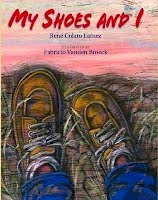
My Shoes and I


On Monday, Febrary 1st my picture book MY SHOES AND I was released! Look for it on line or in your favorite bookstore.

When I was fourteen years old, my father and I crossed the Mexican/ USA border. I still remember those new shoes that my mother sent me from the United Stated. My shoes traveled with me all the way from El Salvador. At the end of the long and tiring journey my shoes had holes everywhere. In MY SHOES AND I, I am telling my story and the stories of thousands of children who need to cross borders in order to accomplish their dreams. Fabricio Vanden Broeck illustrated the book using the retablo's style. My Shoes and I was published by Boyds Mills.

Here is the text of the first scene:

For Christmas, Mamá sent me a new pair of shoes from the United States.

I love my new shoes. They walk everywhere I walk. They jump every time I jump. They run as fast as me. We always cross the finish line at the same time.


“Mario, these are very good shoes for the trip,” Papá says.

Papá tells me that it is a very long trip. We need to cross three countries. But no matter how long the trip will be, I will get there. My shoes will take me anywhere.


Rene Colato Lainez is the Salvadoran award-winning author of many children’s books. In 1985, René, his shoes, and his father left El Salvador to come to the United States. Now, René lives in Los Angeles, California, where he is a teacher.

Fabricio Vanden Broeck has illustrated a number of books for children. He teaches at the Universidad Autonoma Metropolitana in Mexico City, where he lives.

Saturday, February 6, 2010

New Release from Pat Mora in Time for Valentine's Day: Dizzy in Your Eyes

Per request, we will be adding a few titles throughout the year for teen readers. We are happy to start off with the latest title from Pat Mora. Wouldn't this be a great Valentine's gift?

A collection of fifty poems about love: Shared and unrequited. Lasting a moment and lasting a lifetime. Love for a pet, a sport, music. And love for a boyfriend or girlfriend, family, our world. This collection explores the intensity, pain, and beauty that love brings - from first crush to love's bloom, from a breakup catastrophe to starting over. Love is an experience that makes us think: No one has felt like this. Ever. It can make us look at someone and feel dizzy in his or her eyes.

Reading Level: Teens/High School

“From family and school to dating and being dumped, the subjects in these 50 poems cover teens’ experiences of love in many voices and situations. Several entries incorporate Spanish words and idioms, as in “Ode to Teachers,” a moving tribute in English with a Spanish translation … Mora writes in free verse, as well as a wide variety of classic poetic forms—including haiku, clerihew, sonnet, cinquain, and blank verse—and for each form, there is an unobtrusive explanatory note on the facing page. The tight structures intensify the strong feelings in the poems, which teens will enjoy reading on their own or hearing aloud in the classroom.”—Booklist

Wednesday, February 3, 2010

February's Libro del Mes: Arroz con leche

Arroz con leche
Popular Songs and Rhymes from Latin America
Selected and illustrated by Lulu Delacre


The LBBC’s recommendation for Feruary’s Libro del Mes, is Lulu Delacre’s Arroz con leche.

The LBBC is terribly fond of Latino children’s literature that celebrates the oral traditions of our childhood. And despite the diversity of our Latino culture, there is comfort and warmth in the knowledge that many countries share the same (or similar) arrullos, folksongs, nursery rhymes and finger plays. So, naturally, we have featured several and are glad to add one more.

Delacre’s book is one of the first of its kind to have found its way into publication. It was published in 1989 by Scholastic, the largest publisher and distributor of Spanish-language books in the U. S. It prints over 100 bilingual or Spanish-language books per year.

Not many Latinos grow up without learning the popular children’s song, Arroz con Leche. But when Delacre went in search of a book that taught about it and other Latino folksongs for her own children, she was disappointed. Seeing the need, she began selectin the most popular songs from Latin for a book. She partnered with Elena Paz, who wrote the English lyrics, and Ana-María Rosado, who created the musical arrangements.

The end result is a valuable collection of traditional nursery rhymes and finger plays told throughout the Latin America. She credits the countries of Puerto Rico, Mexico and Argentina for the songs’ origins, but I would hazard to guess that they could be heard in numerous other countries as well.

The content is varied and includes favorites such as ¡Qué lina manito!; Aserrín, asserán; Naranja dulce; and, of course, Arroz con leche.

How many of you recognize the following?

Estaba la pájara pinta
Sentada en un verde limón,
Con el pico recoge la hoja
Con la hoja recoge la flor.
¡An, ay, ay! ¿Dónde estará mi amor?

If you would like to buy your own copy of Arroz con leche, please click here. Or you can follow the link in our sidebar to the LBBC’s on-line store. We have both new and gently used copies available.

Wednesday, January 27, 2010

The 2010 Pura Belpré Award Winners

The 2010 Pura Belpré Awards have been announced!

Named for the first Latina librarian at the New York Public Library, the Pura Belpré Award is presented to a Latino/Latina writer and illustrator whose work best portrays, affirms, and celebrates the Latino cultural experience in an outstanding work of literature for children and youth.

For your convenience, we have a special section in our on-line bookstore which includes the books of this year’s winners, as well as all previous winners of this special award. Just click on our store image in the sidebar and then click on the Pura Belpré category.
To learn more about the Pura Belpré Award, click here.

This year’s winners include the following books:

Author Award


Return to Sender, written by Julia Alvarez.

Julia Alvarez explores the thin line that separates American citizens and undocumented persons in her brilliantly told novel, "nder." After Tyler’s father is unable to maintain the family farm, he hires undocumented workers, resulting in an interdependent relationship that mirrors current social and political conditions in the United States. Alvarez humanizes a situation by giving a voice to millions of immigrants experiencing similar hardships. This outstanding novel about the solidarity between two children of different cultures will resonate in the hearts of readers of any age.

Illustrator Award

Book Fiesta!: Celebrate Children’s Day/Book Day; Celebremos El día de los niños/El día de los libros, illustrated by Rafael López, written by Pat Mora.

Rafael López utilizes vibrant colors and applies magical realism to show that the love of reading is universal. Through a series of fanciful images, the author depicts Latino children inviting children of other cultures into their book fiesta, leading the reader on a visual journey that shows that reading sparks the imagination across all cultures and has the power to unite us. This informational children’s book will also serve as a valuable resource to those planning El día de los niños/El día de los libros in their communities.

Author Honor Books


Diego: Bigger Than Life, written by Carmen T. Bernier-Grand, illustrated by David Diaz.


Federico García Lorca, written by Georgina Lázaro, illustrated by Enrique S. Moreiro.


Illustrator Honor Books


Diego: Bigger Than Life, illustrated David Diaz, written by Carmen T. Bernier-Grand.


My Abuelita, illustrated by Yuyi Morales, written by Tony Johnston.


Gracias Thanks, illustrated by John Parra, written by Pat Mora.

Tuesday, January 19, 2010

Spanish Language Creative Writing Contest

For our readers in Nebraska, you might see if your students/children would be interested in submitting to the following writing contest:

The University of Nebraska is sponsoring a Spanish language writing contest about Latino's and Latin American immigrants' contributions to communities across Nebraska. The contest is open to children in grades 5 through 12.

Submissions are accepted in the following categories: Poetry, Short Narrative, and Essay.

First, second, and third prizes in each category will receive $100, $50, and $25 gift certifcates respectively.

The goal of the contest is to celebrate the Spanish language and encourage its creative use among bilingual, heritage speakers, and speakers of Spanish as a second language.

The deadline for submitting to the contest is March 5th, 2010 and the winning entries will be displayed in May at the Ollas Cumbre 2010/Fourth Latino/Latin American Summit of the Great Plains.

For more information, or to download your registration form, visit their website here.

Wednesday, January 13, 2010

Baseball on Mars/ Béisbol en Marte

by Rafael Rivera and Tim Hoppey
Illustrated by Christina Rodriguez

A boy and his father bond over a game of catch on the Red Planet

Roberto's dad speaks in Spanish when he gets upset, and boy, is he unhappy today! His lucky chair-the one he sits in to watch his beloved New York Yankees play-is missing. And he needs it for the afternoon game against the Red Sox!

Roberto is excited, too. He's about to take off to Mars on his home-made rocket ship, and his dad's lucky chair makes a perfect pilot's seat. When his father finds that the missing chair has become part of the rocket ship in the backyard, he grudgingly tells Roberto he can use it-for now. But it needs to be returned before game time.

Roberto's dad is skeptical about the rocket ship. "You might have a problem getting off the ground," he says. "You're forgetting one little thing-you don't have an engine!" Soon, he finds himself invited along as co-pilot. And during the exciting flight to Mars, Roberto helps his father rediscover his imagination as they experience an amazing blastoff, wayward asteroids, and even weightlessness. 

When they finally land, Roberto surprises his father with two baseball gloves and a ball. "Today's baseball game is on Mars," he tells his dad. After spending the day playing catch, father and son realize that they speak the same language on the Red Planet. And his dad doesn't even mind that he missed the Yankees' game!

Children ages 4-8 will want to embark on their own mission to Mars after reading this story that combines vibrant illustrations with a touching story about a father and son's afternoon adventure.

Saturday, January 9, 2010

El tesoro de los clásicos infantiles

From time to time I stumble upon really great finds. One of my most recent successes has been a nearby shop that opened right before Christmas. The absolute best part of this shop is their book selection. And tucked in a corner is a small section of books in Spanish for children.

One of the many treasures I found there was El tesoro de los clásicos infantiles. It is a thick book with 10 English classics that have been translated into Spanish. Definitely not for beginners, the translations are complex and dynamic and expertly done by Claudia González Flores and Arlette de Alba. The language is rich and detailed – perfect, I think, for encouraging and even inspiring bilingual children. Parents of toddlers who are fluent in Spanish and are looking for ways to supplement their language development will absolutely love this book.

In addition, the illustrations are very well done, with each story using a different artist. The entire book has been thoughtfully arranged and the layout is sophisticated and classic.

The ten stories included are:

• Robin Hood
• Heidi
• La Isla del Tesoro
• El Robinson Suizo
• Los Viajes de Gulliver
• Azabache (Black Beauty)
• El Jardín Secreto
• Alí Babá
• Los Tres Mosqueteros
• Anita de Green Gables

I have one copy in my possession that is new but has a minor crease in the binding. Normally, this book retails for $17.95 (which is what you will find it listed for in our bookshop), but this particular copy is for sale in the Latin Baby boutique for $12.95. You can also find Clásicos Infantiles in our bookshop by clicking on the button in our sidebar.

Sunday, January 3, 2010

January's Book of the Month: Growing Up with Tamales

Growing Up with Tamales
Los tamales de Ana

By Gwendolyn Zepeda
Illustrated by April Ward

The LBBC’s recommendation for January’s Libro del Mes, is Gwendolyn Zepeda’s Growing Up with Tamales/Los tamales de Ana.

Growing Up with Tamales is an imaginative story that centers around the family tradition of making tamales. The tale is told from the perspective of six year old Ana, who yearns to be just like her big sister, Lidia. Two years younger than her sister, Ana imagines what her life will be like when she is Lidia’s age…at eight, ten, 12, 14, 16, and finally 18. The funny ending is sure to amuse its readers!

The book itself is written with complete text in both English and Spanish. The copy that I received, however, is from Lorito Books and is an audiobook set. The accompanying CD is read by Denver stage actress, Gabriela Cavallero, whose expressive rendition in flawless English and Spanish will delight listeners of any age.

April Ward’s illustrations are warm and colorful. She does a remarkable job depicting Ana as she "grows up" into a young woman. And the character’s faces are expressive, telling stories in themselves.

Growing Up with Tamales is a Charlotte Zolotow Award Highly Recommended Title and a Tejas Star Book Awards Finalist.

A great book for children with brothers and sisters. Parents and teachers can discuss the topics of families, sibling dynamics, family traditions, added responsibilities that come with age, and what the child reader hopes to be like as he or she grows older.

If you would like to buy your own copy of Growing Up with Tamales, please click here. Or you can follow the link in our sidebar to the LBBC’s on-line store. We have both new and gently used copies available.

If you would like to order this book with the accompanying CD, click here to visit Lorito Books.